Occasional journal posts in between gardening or working
From Sylvia Townsend Warner's lost short story, now found
"Flowers," here printed in March 2012 (The Guardian).
"You can sit there and be lovable, whether you like it or not," said Mary Ryan to the zinnia, which she had now replaced in the bowl.
And, one packet of seeds arrive today, with these improbable green-maroon zinnias. :)
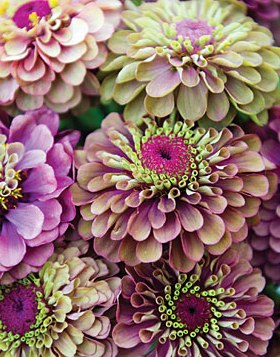
Burpee Seed Company "Queen Red Lime"
 MinxterBloom
 Post a Comment
Another book post, with witches
Over the winter break, a dear friend listened patiently to my New Year's resolution to try outdoor distillation or hydrosol formation with some of my plants. A day later, she sent me a link to an ebook as a gift: Lolly Willowes by Sylvia Townhend Warner. Warner held some association with the Bloomsbury group, via Stephen Tomlin and David Garnett.
What a delightful and quick read! I wish the 1926 book were longer, so I keep thinking about Lolly. Laura, better as Lolly, moves to the country after a nearly 20-year stint as the most excellent auntie to two London children. Not long afterwards, Lolly understands that her pleasant transformation is that of a becoming a witch.
Plants figure highly, hence my love of this book and this post. Here are a few quotes;
“London life was very full and exciting [...] But in London there would be no greenhouse with a glossy tank, and no apple-room, and no potting-shed, earthy and warm, with bunches of poppy heads hanging from the ceiling, and sunflower seeds in a wooden box, and bulbs in thick paper bags, and hanks of tarred string, and lavender drying on a tea-tray.”
“She forgot that she was in London, she forgot the whole of her London life. She seemed to be standing alone in a darkening orchard, her feet in the grass, her arms stretched up to the pattern of leaves and fruit, her fingers seeking the rounded ovals of fruit among the rounded ovals of leaves.”
“It is best as one grows older to strip oneself of possessions, to shed oneself downward like a tree, to be almost wholly earth before one dies.”
...to shed oneself downward, like a tree...

Chilly today, with no snow
But, we have this. Perhaps winter in 2013 will be digital.
By Sam Arbesman
Book snippet: "wild with longing"
Ida Elisabeth, by Sigrid Undset, has this to say about my reaction to flowers.
It made her green with envy to go past windows which had swelling tea-roses and bright bunches of red and white pelargoniums pressing against the panes. Marit, for instance—she had a huge green window-box full of Jacobæa lilies; in summer it was like a regular thicket of long, narrow dark green leaves arching and crossing one another, and then in autumn came the flowers, as many as twenty at the same time. . . . Ida Elisabeth felt wild with longing; she did not quite know for what, as she sat and looked at all these tall, stiff stalks with bunches of great staring red calyxes—the colour was so strange, so bright and clear, and the shape of each separate flower seemed so perfectly clean-cut and strong.

Sorry to have not posted earlier, due to flu and general busy-ness. The semester begins on Wednesday. In other matters, I am part of a science project involving the remediation of chicken farm exhaust by plants, namely Austree willow, Arbor viitea, Miscanthus, and Panicum (swithgrass). Think high tech hedgerows.
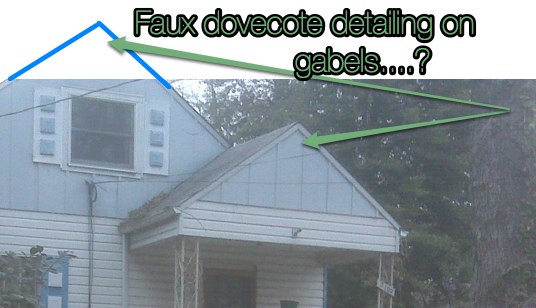
Faux dovecote architectural detail

Retrorenovation's piece on dovecotes as part of storybook architecture planted a (bird) seed in me. I want to try something like this with square lattice over the attic vents on both the front and back gables. Can I incorporate Osmia bee houses? Perhaps.
Here is a Pinterest board on dovecotes.
I will likely buy from Crown Bees. My first mason bees came from UMD, but they are still on the Beechwood Road plot.